Android app — viewer guide
This page is for viewers using the Aliran app on an Android phone, tablet, or Android TV — the public build that connects to any Aliran service. If you run the service itself, use the client build page instead. Operators can link or copy this guide for their viewers.
1. What it is
The Aliran app is a TV app for your phone, tablet, or Android TV. One APK works on both: touch on a phone, remote or D-pad on an Android TV. It has channel numbers, zapping, favorites, and a program guide. You sign in to a service that someone else operates — a channel lineup they curate — and you watch it fullscreen.
One thing makes it different from an ordinary streaming app. The video travels peer-to-peer: while you watch, the app also shares pieces of the stream you've already received with other viewers of the same service. This is what lets a small operator serve many viewers without a big server. The app uses upload bandwidth while a channel plays, and it stops when you close the app. On mobile data it behaves better than most apps like this — see §9 for the details.
2. Install
Your operator hands you an APK file — usually
aliran-android-public-arm64-v8a.apk, or their own branded name. Or you can
download the generic public build yourself from the project's
releases page.
Pick the arm64-v8a APK for real phones and TVs; the smaller armeabi-v7a
one is for older 32-bit TV boxes and sticks.
The app isn't from an app store, so Android asks you to allow the install:
- Phone / tablet: open the APK — from Files, your browser's downloads, or a link your operator sent. Android asks to allow installs from that app. Allow it once ("Install unknown apps"), then tap Install.
- Android TV: put the APK on a USB stick and open it with a file manager from the Play Store (for example "File Commander"), or use a "send files to TV" app. You'll see the same "unknown sources" question, and the same Install. The app then appears in the TV launcher's app row like any other channel app.
Playback needs Android 10 or newer. This is a hard floor of the P2P engine, not a preference — older devices, including all Fire OS 7 sticks, cannot load it. Most TVs and phones from 2020 on are fine. The APKs themselves install from Android 7, so one file can go out to a mixed fleet. But on Android 7–9 the app shows an "engine not supported on this device" notice instead of playing — installing does not mean it can play.
Why the "unknown sources" warning? Community builds are distributed directly, not through Play. The warning is Android's standard gate for that. If you got the file from your operator, proceed. If you got it from somewhere you don't trust, don't.
3. First run: connecting to your service
The app opens on a Connect screen and asks for three things. All three come from your operator — you don't need to figure out anything yourself:
| Field | What it looks like |
|---|---|
| Pairing code | 12 characters in three boxes of four, like A3K7-9QF2-M4XR — the boxes move you along as you type |
| Username | your account name on that service |
| Password | your account password |
There's no server address or URL to enter. This isn't an oversight — the app finds your service on a global peer-to-peer network from the code alone. The code is public: it names the service, but it doesn't unlock anything. Your password is what signs you in, and it never leaves your device in readable form.
Type the code in upper or lower case — either works. If your card shows an
O or an I, type it as you see it; the app reads them as zero and one.
Some operators hand out a panel key instead: 64 letters and digits
(0–9, a–f). Press Enter the 64-character panel key instead and paste
it there. Both routes reach the same service.
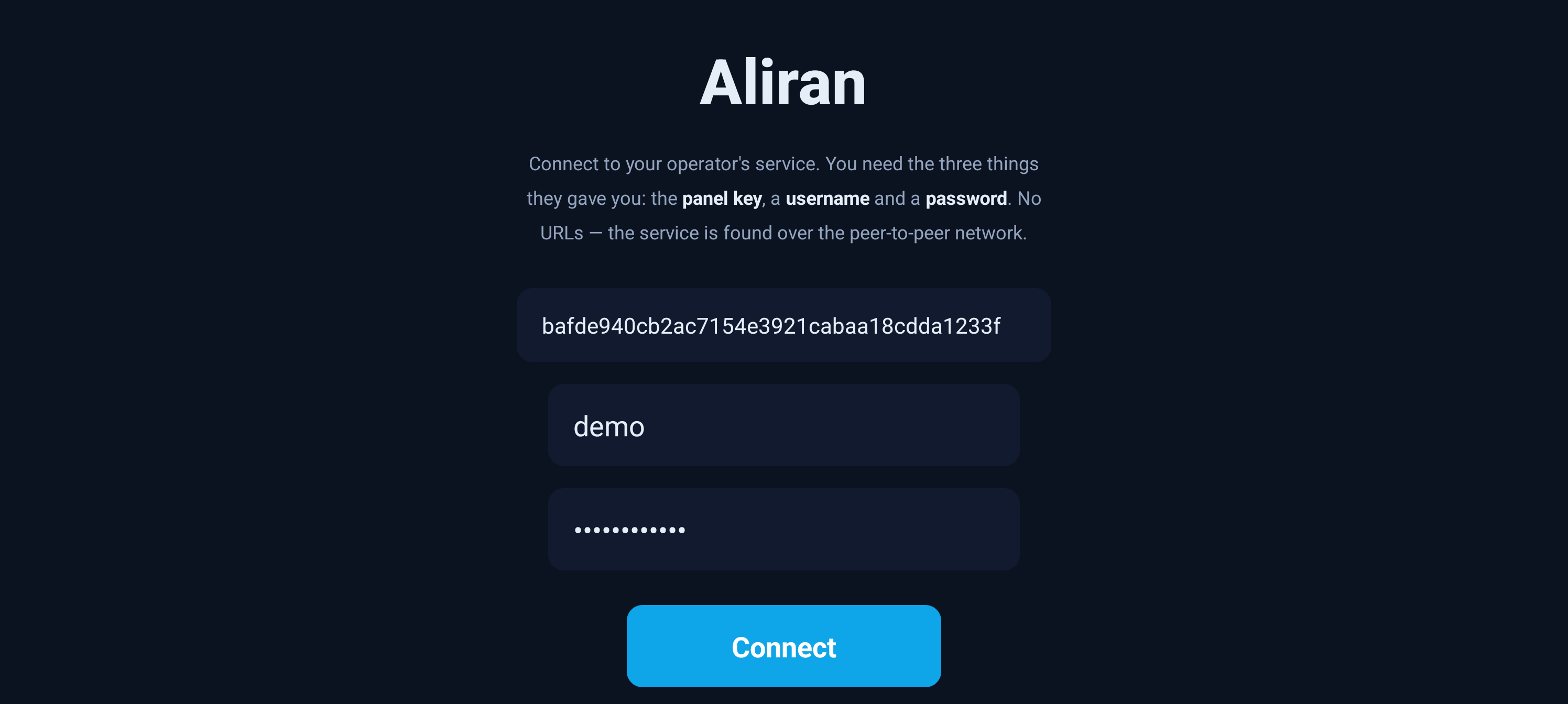
Press Connect. The first connection can take a minute or two while the app finds the network. If it reports the service unreachable on the very first try, press Connect again — the app keeps looking in the background, and the second attempt usually lands. After that, the app remembers everything, and every later launch goes straight to live TV. Still stuck? See §10.
(The screenshots in this guide show a small demo service broadcasting colour bars — your operator's channels appear the same way, with their own names, logos, and programs.)
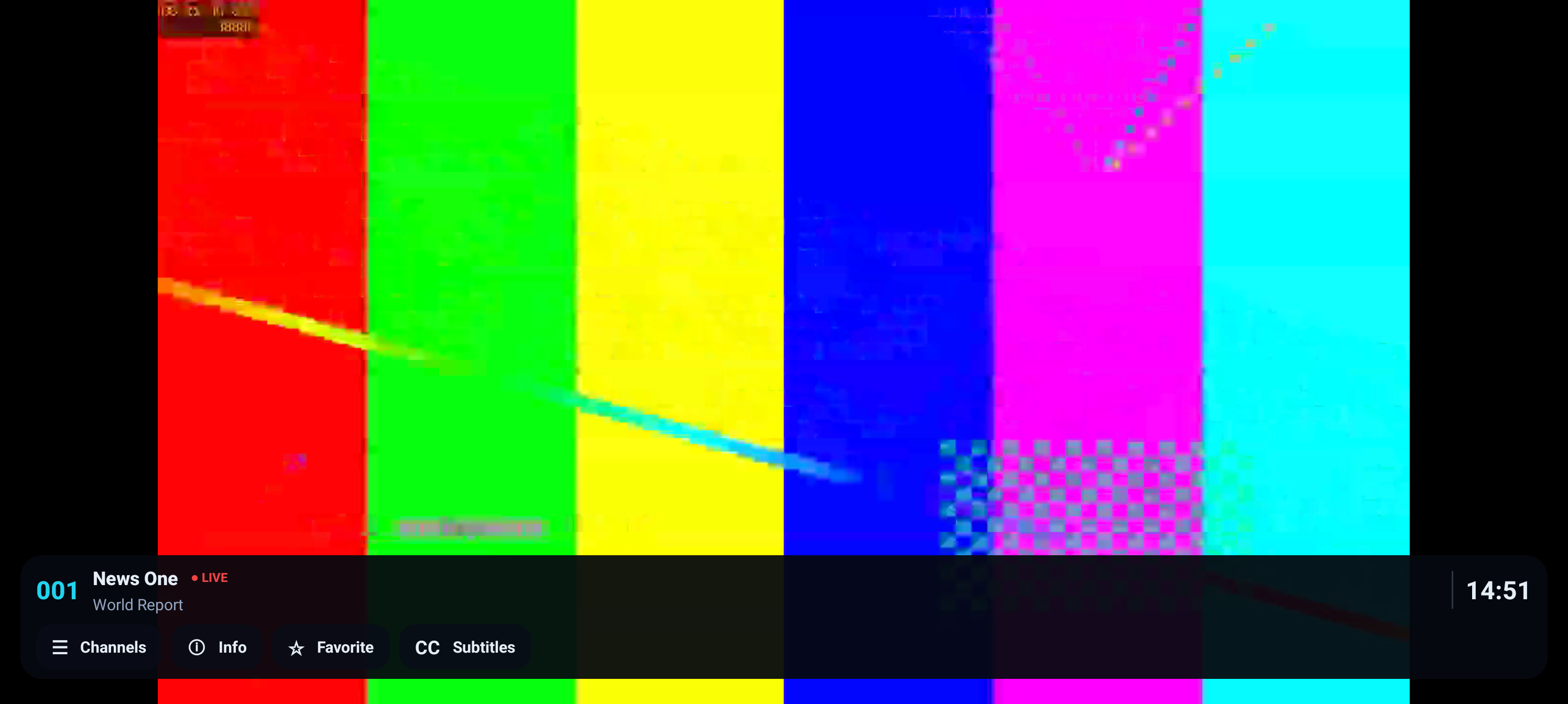
4. Watching TV on a phone
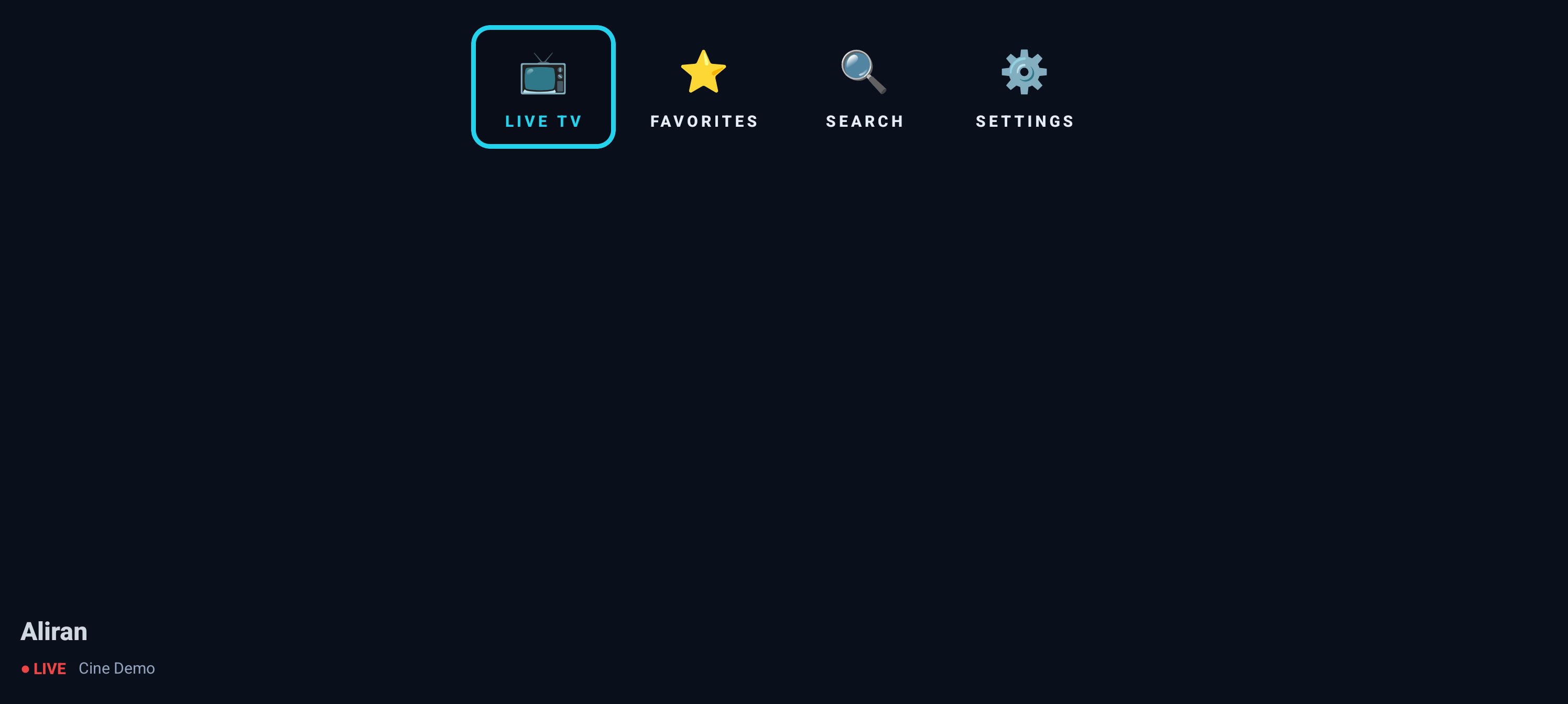
The menu hub has Live TV, Favorites, Search, and Settings. Open Live TV and you're watching. Everything else happens in overlays, while the video keeps playing:
| You want to | Do this |
|---|---|
| Open the channel list | tap the screen |
| Browse by category | in the list: the category rail is on the left; categories with › have sub-categories |
| Change channel | tap a row in the list — the video switches in place |
| See channel details / the program guide | long-press a row ("hold for details"), or tap ⓘ on the bottom bar |
| Add/remove a favorite | the ★ button on the bottom bar (or in the detail panel) |
| Subtitles / audio language | the CC button on the bottom bar — shown only when the current channel actually carries tracks |
| Bring back the bottom bar | tap near the bottom of the screen (it fades out over clean video) |
| Go back / close a panel | the Android back gesture/button |
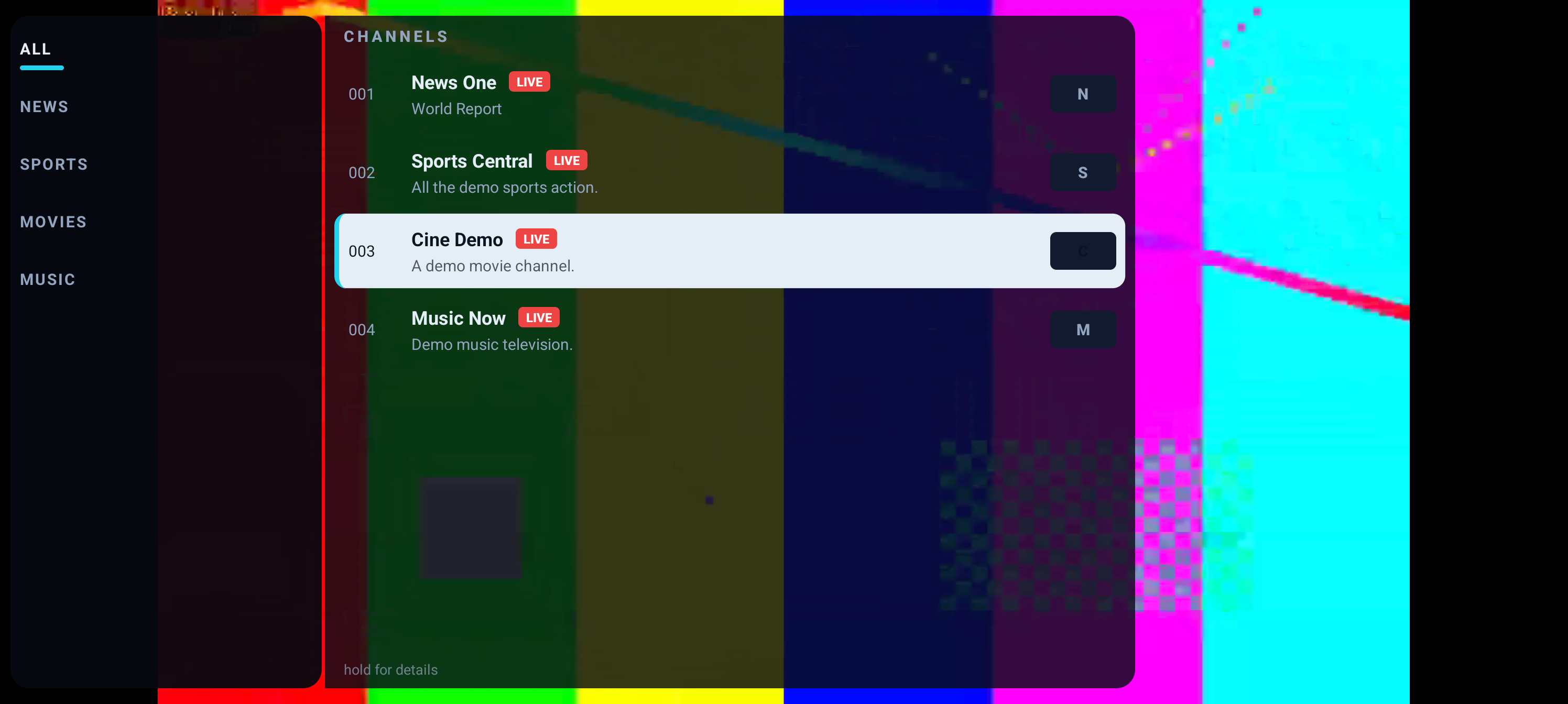
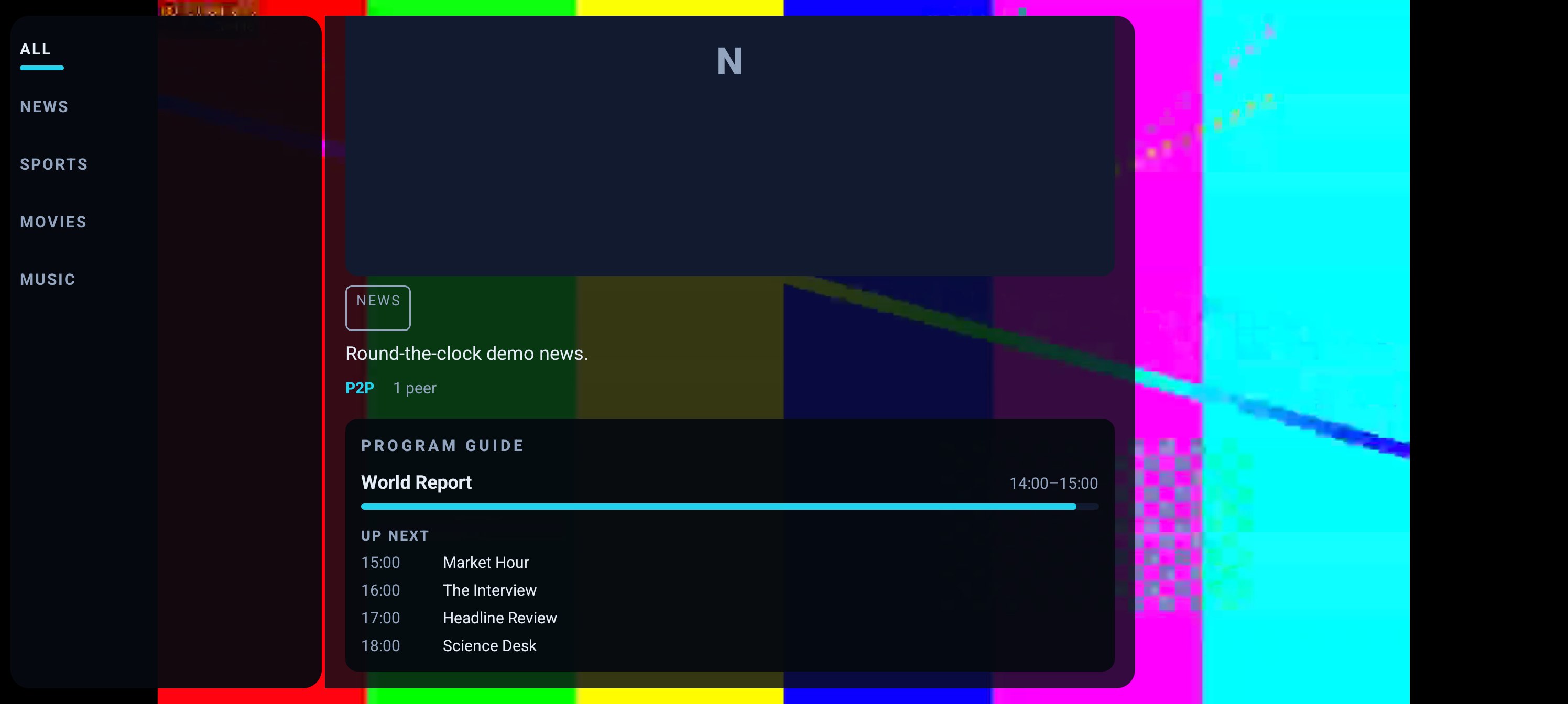
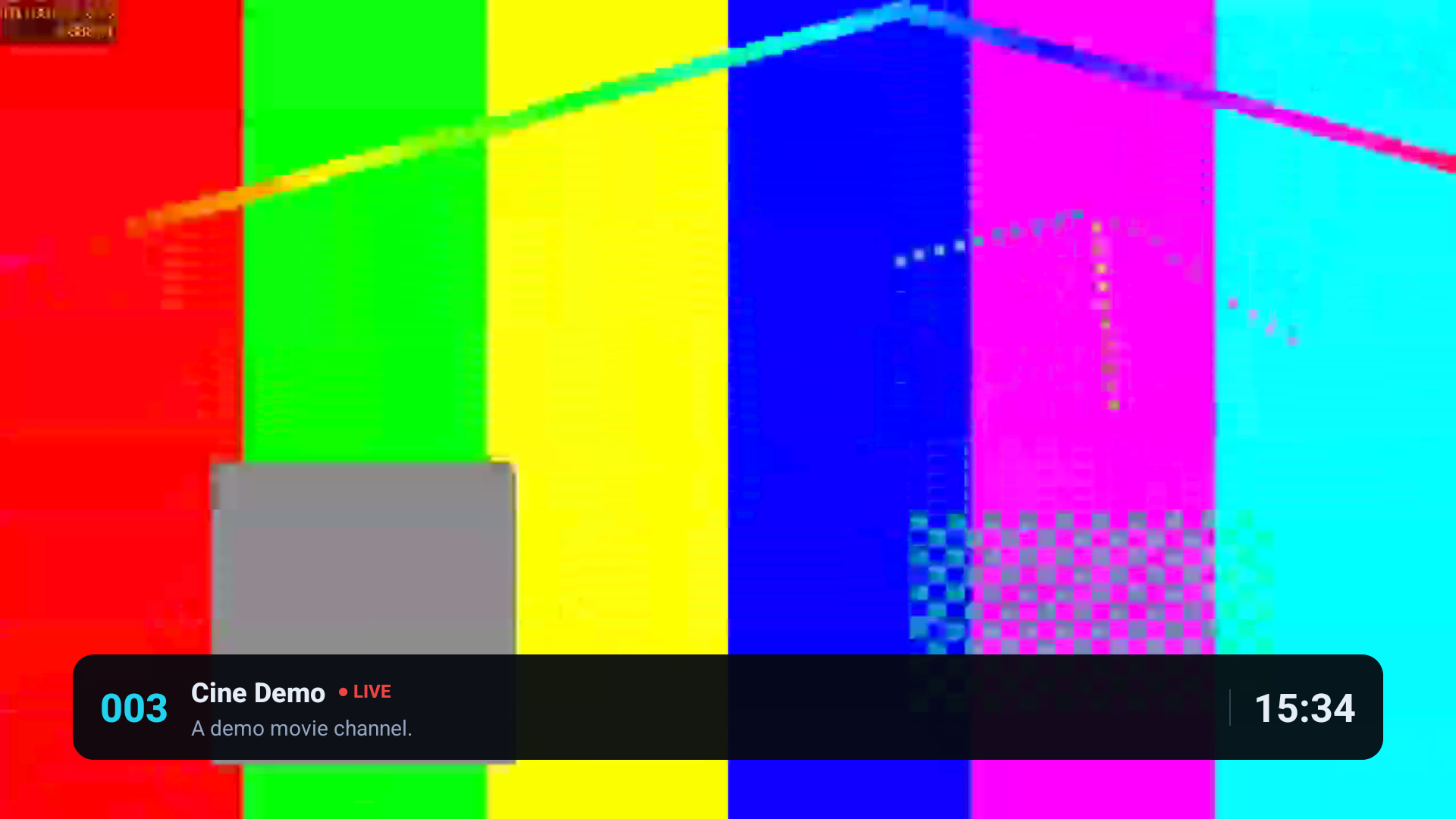
The bottom bar shows the channel number, name, what's on now (when the channel has a guide), and the clock. On on-demand titles it becomes a play/pause and seek transport instead.
5. Watching TV on an Android TV
Same app, driven with the remote:
| You want to | Do this |
|---|---|
| Change channel | D-pad up / down while watching fullscreen — zaps through the whole lineup in channel-number order |
| Open the channel list | OK / center while fullscreen |
| Browse by category | in the list: left into the category rail, up/down, OK; categories with › drill into sub-categories |
| See channel details / the program guide | long-press OK on a channel row |
| Add/remove a favorite | in the channel detail panel |
| Subtitles / audio language | the CC control in the detail panel (only when the channel has tracks) |
| Go back | Back — closes the current panel, then exits to the menu |
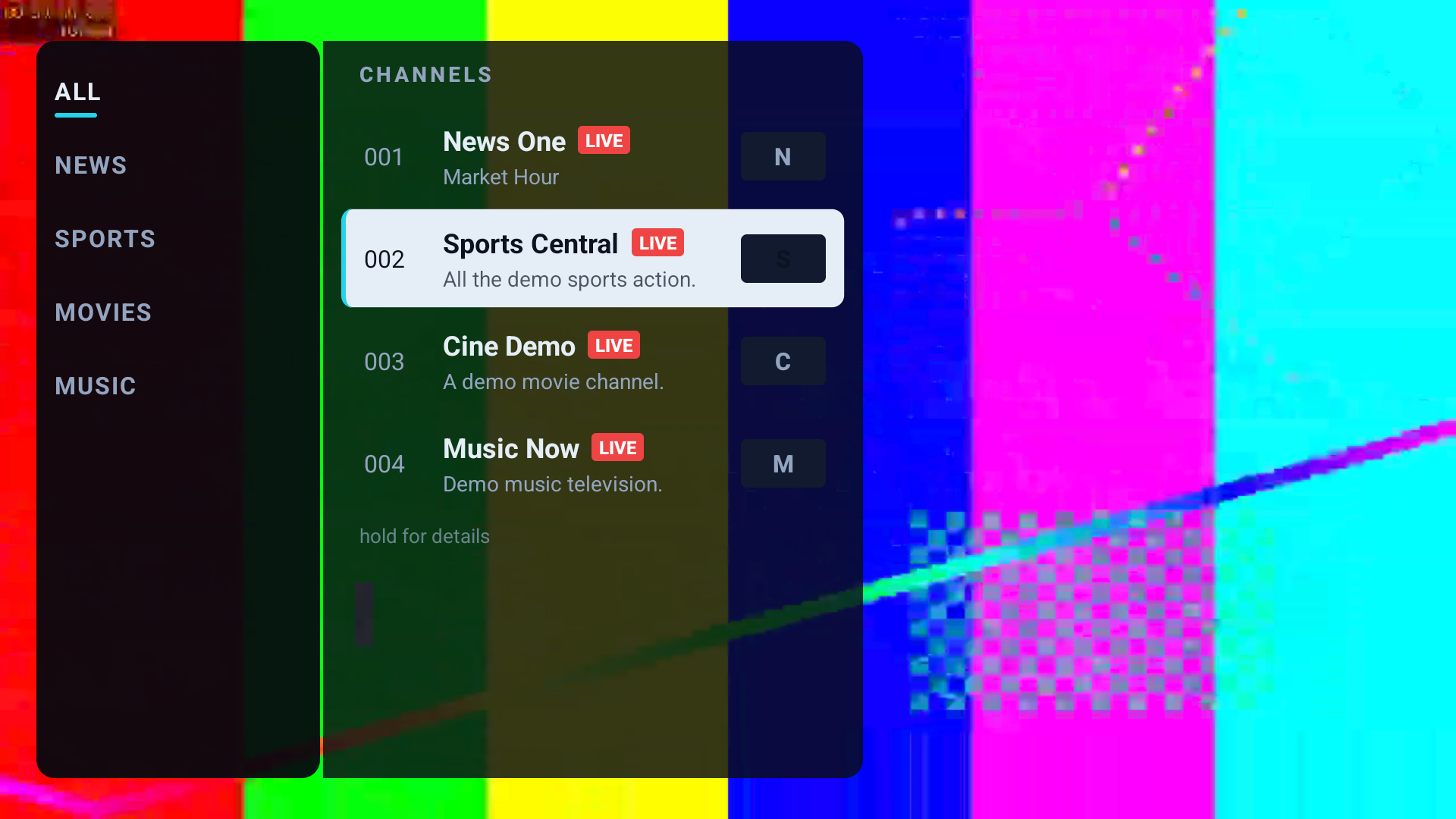
The list overlay hides itself after a few idle seconds, leaving clean fullscreen video. Tuning takes a moment: the top-right pill shows progress while a channel starts. Channels near the one you're watching often start faster, and the optional Smooth zapping setting (below) makes surfing near-instant.
6. Movies & Series (if your service has them)
Some services add a Movies & Series tile to the menu — an on-demand catalog next to the live channels. Inside it:
- The left menu switches between Movies, Series, and Search. Search is its own screen, with a result grid.
- The tab bar on top — Recommended · My List · Genres · All — works the same for movies and series. Recommended shows "Recently added" and "Newest releases" rows. Genres shows one card per genre. All is the full grid.
- The "Sort by" chip above the grid opens the sort menu: Recently added, A-Z, Newest releases, Oldest releases, Recently watched. On the A-Z sort, a letter rail appears on the right edge. Tap it, or D-pad into it, to jump to a letter.
- My List: long-press a poster (hold OK on a TV remote) to add or remove a title. You can also add a series from its detail page.
- Series open a detail page: pick a season, pick an episode, and it plays. Start plays the next episode from where you left off.
- Titles resume from where you stopped watching. The Recommended tab starts with a Continue watching row, so a title you left is one tap away.
- On the phone, the player controls fade out over the video. Tap the screen to show them again. Pause keeps them visible. Under the progress bar there are skip buttons (30 and 10 seconds, in both directions) around play/pause, and a speaker button with a volume slider — your hardware volume keys also work. The ⋮ button selects the subtitle and audio languages when the title has them.
Your list and your watch history are stored only on this device. The app never sends them to your operator or anyone else, and clearing the app's data erases them.
7. Settings worth knowing
- Smooth zapping — preloads the neighboring channels while you watch, so zapping feels instant. It costs extra download bandwidth while a channel plays, which is why it's off by default. It also pauses itself automatically on limited connections, or when your stream is struggling.
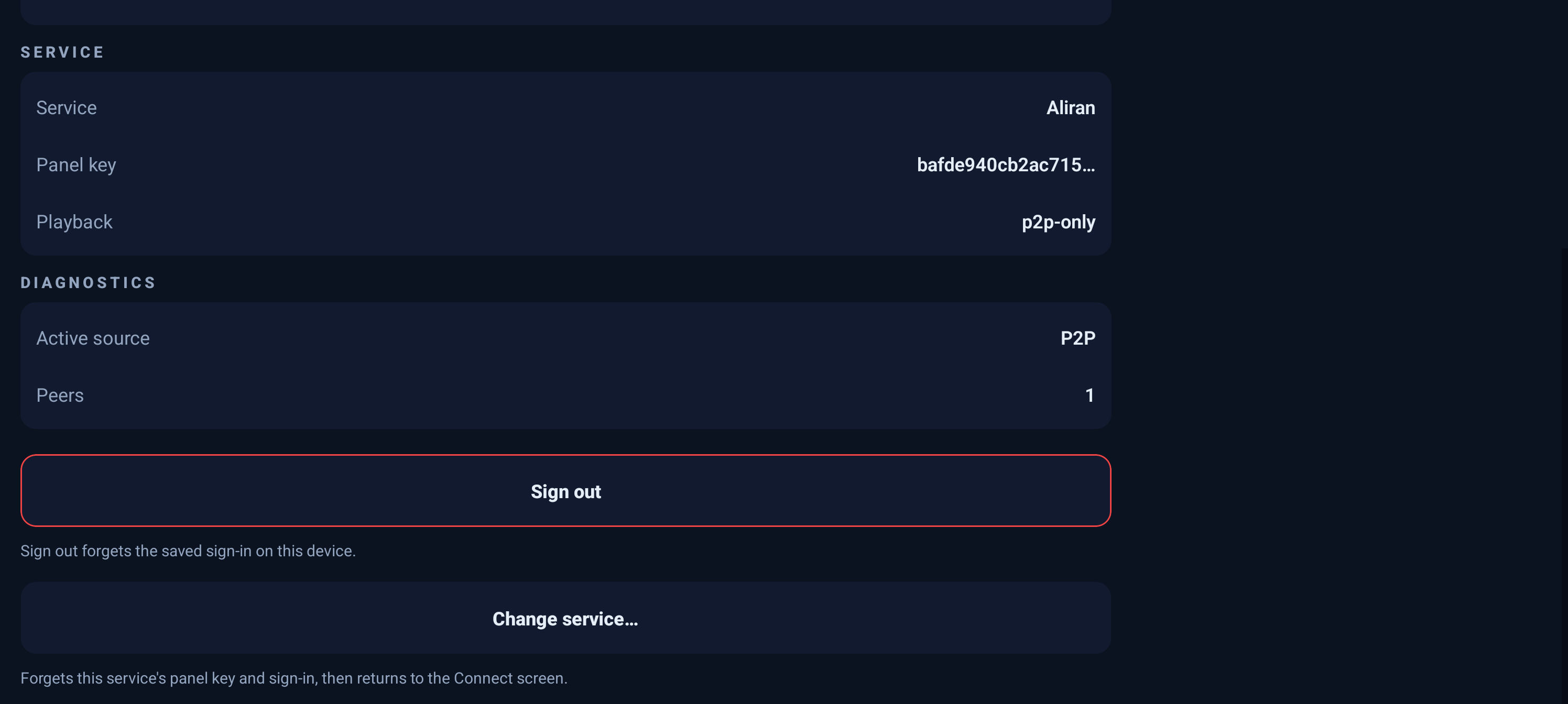
- Sign out — forgets your saved sign-in on this device. Use it on a shared device. The service stays connected, so the next person just signs in.
- Change service… — public builds only. Forgets the service's panel key and your sign-in, and returns to the Connect screen. Use it to switch to a different operator. Builds an operator shipped with their key baked in don't show this option — there's nothing to change.
- Diagnostics — shows whether the current channel comes peer-to-peer
(
P2P, with a peer count) or from a direct internet source (CDN).
8. Your account and devices
Your operator sets a device limit for your account — commonly a few devices. Each phone or TV you sign in on takes one slot. Going over the limit signs out the oldest device. If you're unexpectedly signed out, this is the usual cause. Sign in again, or ask your operator to raise your limit.
9. Privacy & bandwidth, honestly
- What the app uploads: encrypted pieces of the streams you watch, or recently watched, served to other viewers of the same service. Nothing else. The app cannot upload anything you didn't already download as part of watching.
- Mobile data is respected: on cellular or a metered hotspot, the app stops re-seeding to other viewers automatically — your own playback is unaffected — and pauses the Smooth-zapping preload. Upload resumes once you're back on unmetered Wi-Fi.
- What others can see: other viewers' apps see an anonymous peer serving stream data — not your name, account, or watch history. Your operator, like any streaming provider, knows your account and what it can access.
- Your password is processed with a cryptographic protocol (OPRF) that never sends it in readable form. Not even the operator's server sees it.
- Your saved sign-in lives inside the app's private storage on the device. This is standard Android app sandboxing — other apps can't read it. Anyone you hand the unlocked device to can open the app already signed in, like any TV app.
10. When something doesn't work
| Problem | What it means / what to do |
|---|---|
| Connect fails after ~1 minute: "Cannot reach the service" | Press Connect again first — the app keeps dialing in the background, and the retry usually lands. Otherwise, check for: no internet, a network that blocks peer-to-peer traffic (some office/hotel networks), or a mistyped panel key — recheck all 64 characters. |
| "Invalid credentials" | Your username or password is wrong — both are case-sensitive. Ask your operator to reset it if needed. |
| A channel never starts: "the channel may be unreachable right now" | Switch to it again to retry (the app tells you this). If it keeps happening on every channel, your network may be too restrictive for peer-to-peer video. |
| A channel plays audio but no picture, or errors immediately | That channel likely broadcasts in a format this device can't decode — usually HEVC/H.265 on older or cheaper hardware. Other channels keep working; there's nothing to configure. |
| Picture freezes for a few seconds, then recovers | This is normal self-healing after a network hiccup. The app reloads at the live edge, and reconnects deeper if that's not enough. |
| "…is not broadcasting right now" | The channel exists, but the operator isn't feeding it at the moment. Try later. |
| Channel list is missing channels you expect | Your account isn't granted access to them, or a new grant applies at the next sign-in. Sign out and back in, or ask your operator. |
| The app opens on Connect again out of nowhere | Someone used Change service…, or the app's data was cleared (see below). Reconnect once. |
| Everything is wedged | Go to Android Settings → Apps → Aliran → Force stop, then reopen. Still wedged: Clear storage is a complete factory reset of the app — you'll need the panel key and sign-in again. The stream cache it deletes is disposable. |
11. Uninstall / full reset
Uninstall it like any app: long-press the icon, or use Settings → Apps. All app data — the service key, sign-in, favorites, and the stream cache — lives in the app's private storage and is removed with it. Clear storage, without uninstalling, gives you the same reset while keeping the app installed.